
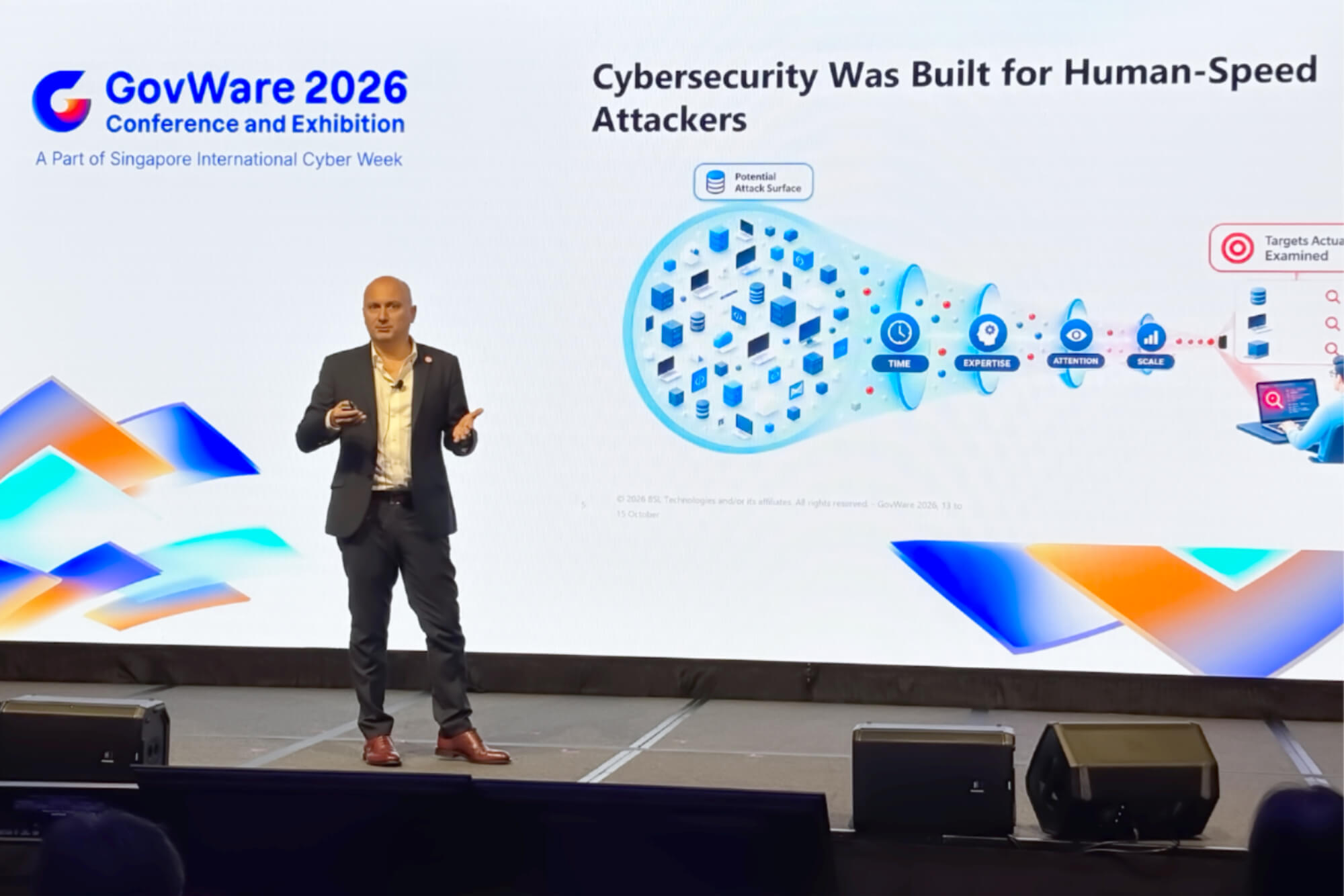
At GovWare 2026 in Singapore, Antonio Varriale, Blu5 Group CTO, explored how offensive AI is reshaping the economics of cyberattacks and why cybersecurity must increasingly be addressed through architectural decisions.
His central argument was that artificial intelligence is not simply making cyberattacks faster. It is changing their economics.
Historically, attackers faced limitations in time, expertise and resources. Offensive AI is progressively reducing those constraints, enabling continuous reconnaissance, large-scale vulnerability examination and increasingly adaptive attack techniques.
As a result, organisations can no longer assume they will always identify and remediate vulnerabilities before adversaries discover and exploit them.
Detection, authentication, vulnerability management and incident response remain essential. However, these controls operate within the conditions established by the underlying network architecture.
When services remain reachable, they can be continuously examined and challenged, regardless of the defensive mechanisms protecting them.
Beyond cyberattacks, the presentation addressed the growing operational dependencies created by cloud services, external platforms and AI-driven capabilities.
As these technologies become embedded in critical processes, resilience increasingly depends on understanding which functions remain operational when external services fail.
Key Takeaways:
These are not simply technology challenges. They are architectural decisions.
The discussion reflected Blu5 Group's broader approach to cybersecurity engineering and cyber resilience: security technologies should be evaluated not only by the defensive capabilities they introduce, but also by the attack conditions they eliminate.
In the age of offensive AI, sovereignty is no longer only political. It becomes architectural.
Blu5 Group
Opportunities
Newsletter


HALL: S3
STAND: C44